Hold Point
Check the parcel's history before you offer, because the same mistake costs more the later it gets caught.
Two habits separate builders who avoid expensive surprises: checking a parcel's history before buying it, and catching errors on paper before breaking ground.
By the end of this lesson, you will be able to run three municipal lookups on any parcel in about 30 minutes and explain why every mistake gets more expensive the later you catch it.
Check the Parcel's History Before You Buy It
Before submitting an offer, run three separate municipal lookups:
Permit History: Check the City of Atlanta Accela portal to verify past permits were properly closed and finaled.
Code Enforcement Records: Pull code enforcement histories separately. Open violations or stop work orders don't always display in standard permit searches.
Tax Assessor vs. Physical Footprint: Compare Fulton or DeKalb County tax assessor square footage against aerial photos and a site visit. An unpermitted garage or addition becomes your legal and financial liability at closing.
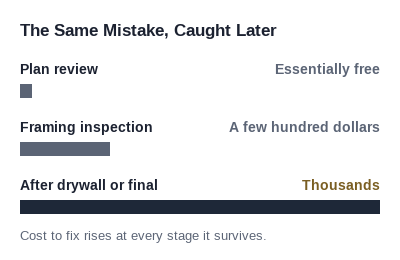
The Cost Escalation Curve
The exact same mistake costs far more the later it is caught:
Plan Review: Essentially free, a red pen correction on a PDF.
Framing Inspection: A few hundred dollars in labor, rework and rescheduled inspection days.
After Drywall or at the Final Inspection: Thousands in demolition, reframing, drywall patching, repainting and carrying costs.
Worked Example: Thirty Minutes Before the Offer
An infill teardown lists at $90,000. Accela shows a permit for a rear addition that was never finaled, and code enforcement shows an open case for an overgrown, unsecured lot. Neither appears in a standard title search.
Now you can act before you commit: price the cure into a lower offer, or write the contract so the seller closes the open case before closing. Either way, the problem stays the seller's, not yours. Have your real estate attorney write that clause.